ART ACADEMY
Ensuring outstanding teaching in Art & Design

WATERCOLOUR LANDSCAPES (Lower Key Stage 2)

Teaching Pack
-
5 Lesson Presentation Slides
-
Knowledge Organiser
-
Medium Term Planning
-
Teaching resources
-
Additional Presentation: Elements of Art
-
Additional Presentation: Using Sketchbooks
-
Additional Presentation: 5 Minute Drawing
-
Additional Presentation: Art Museums
-
Additional Presentation: Landscape Museum
Unit Overview
Sequence of Learning for Teachers
In this unit of work children consolidate and develop their skills in using watercolour paints through the study of landscape painting. Through a series of convergent tasks, children learn that landscapes are paintings of places and scenery such as the countryside, towns, cities or scenes of industry. They learn some of the key techniques of painting landscapes including creating a background, middle ground and foreground for their composition, the use of colour intensity to create visual perspective and how layering can also create a feeling of depth in their paintings. Throughout the series of lessons children are also taught how to use watercolour paints effectively when painting landscape scenes. Children develop their history of art knowledge learning about the landscape paintings of Georgia O’Keeffe and David Hockney. For the creative divergent task, children apply their learnt knowledge and techniques to create an authentic landscape painting.
This knowledge, skills and understanding is delivered through the following convergent task sessions:
Session 1: Introducing Landscapes
Session 2: Rolling Hills and Mountains
Session 3: On the Horizon
Session 4: Overlapping to Create Depth
Creative Outcome (Divergent task) – Masterpiece
The unit of work completes with the creative outcome (divergent task) activity that can be delivered over two or more sessions. These sessions can also be used for children to complete activities from sessions 1-4. For the creative outcome children are tasked with creating their own landscape painting. Ideally children should have the opportunity to visit the locality to make sketches in their sketchbooks and/or take photographs for future reference. They then use these sketches and the landscape painting techniques developed over the unitr of work to create a landscape painting in the style of the artist David Hockney. The creative outcome activity provides an opportunity for children to apply their knowledge, skills and understanding from previous sessions in this unit of work. Through the creative outcome children will develop their creativity and understanding of the creative process by combining their imagination with the knowledge they have acquired.
Learning Sequence
Session 1
Overview: In this session children have the opportunity to deepen their knowledge and understanding of the genre of landscape paintings. This is also an opportunity to develop their skills in using watercolour paints and to apply the 'dip and dab' technique of using watercolours.
They apply this knowledge and skills to add colour to outline drawings of landscape paintings.

Session 2
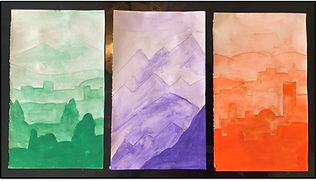
In this session children consolidate learning about how landscape paintings are composed of a foreground, middle ground and background. They focus on the technique of changing the intensity of watercolours and applying this skill when painting landscapes using aerial perspective to crate the illusion of depth.
Session 3
In this session children learn about the importance of using the horizon line when creating landscape paintings. They use the horizon line when creating a sunset painting and apply a range of watercolour techniques such as creating a wash and 'wet on wet' to create their sunset painting. When dry they use 'wet on dry' technique to add silhouettes to their painted sunset.

Session 4
In this session children build upon previous learning about landscape composition and are introduced to the technique of overlapping to create the illusion of depth in landscape painting. They are introduced to the landscape paintings of the artist Georgia O'Keeffe and mimic het style when creating their own overlapping landscape painting.

Creative Outcome
For the creative outcome children are tasked with creating their own landscape painting. Ideally children should have the opportunity to visit the locality to make sketches in their sketchbooks and/or take photographs for future reference. They then use these sketches and the landscape painting techniques developed over the unit of work to create a landscape painting in the style of the artist David Hockney.
